
Flooding damages Montauk State Park and Hatchery
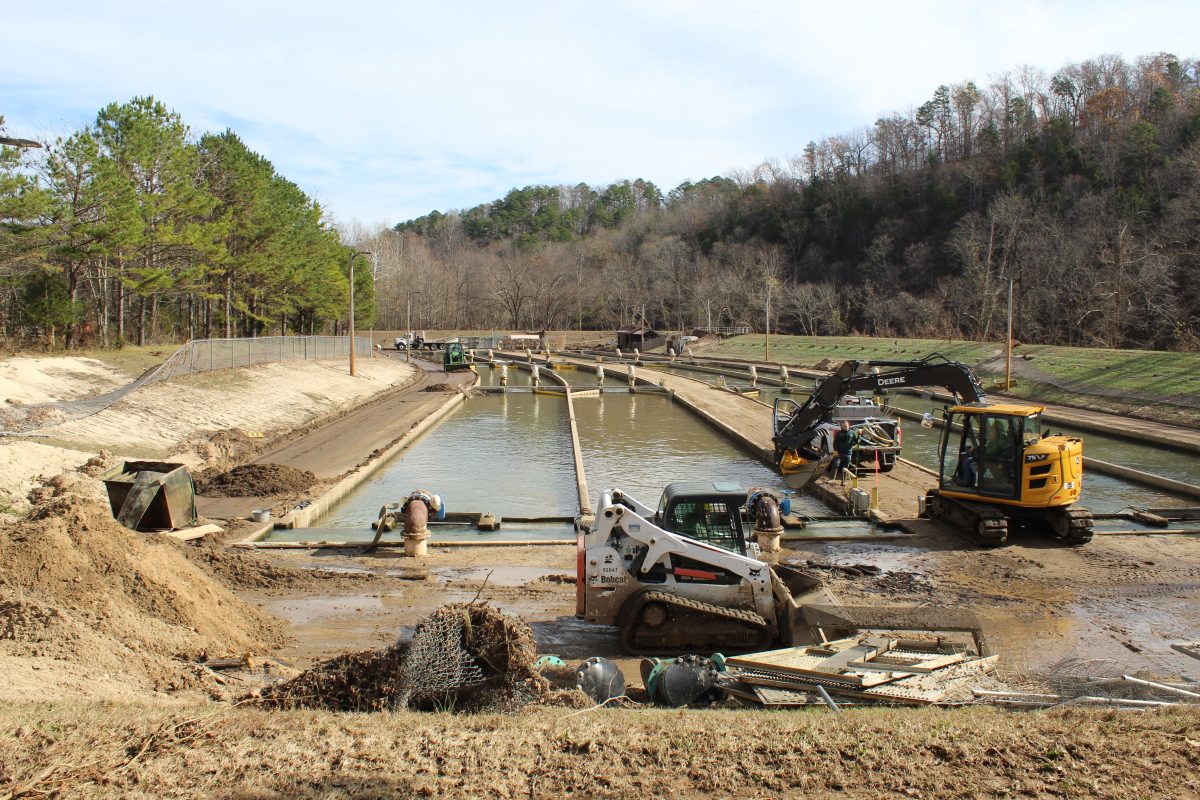
Photo by Shari Harris
Workers dig sand, mud and gravel out of the rearing pools, as others try to clean off the concrete.
By Shari Harris, Publisher
Many organizations, businesses and individuals are busy with recovery efforts after flash flooding and flooding swept through the area early last week.
Montauk State Park received extensive damage to campgrounds, two cabins, and the Hatchery, leaving Department of Natural Resources (DNR) Missouri State Parks employees and Missouri Department of Conservation (MDC) Hatchery staff scrambling to restore order to the park and to save the trout in the hatchery.
Justin Adams, Regional Director for the Ozarks Region of Missouri State Parks, is leading the park cleanup for DNR, along with Peter Hovey, Interim Park Superintendent.
The first thing you notice as you enter the park is sand, on the roads, in the parking lots, covering grassy areas. Driving past the river, those familiar with the park will notice the footbridges are gone, leaving only the pilings to mark their place. After you cross the bridge, Cabins 7 and 8, located on the left, are badly damaged, and it is uncertain whether they will be recoverable. Asphalt damage is intermittent, with some places more affected than others.
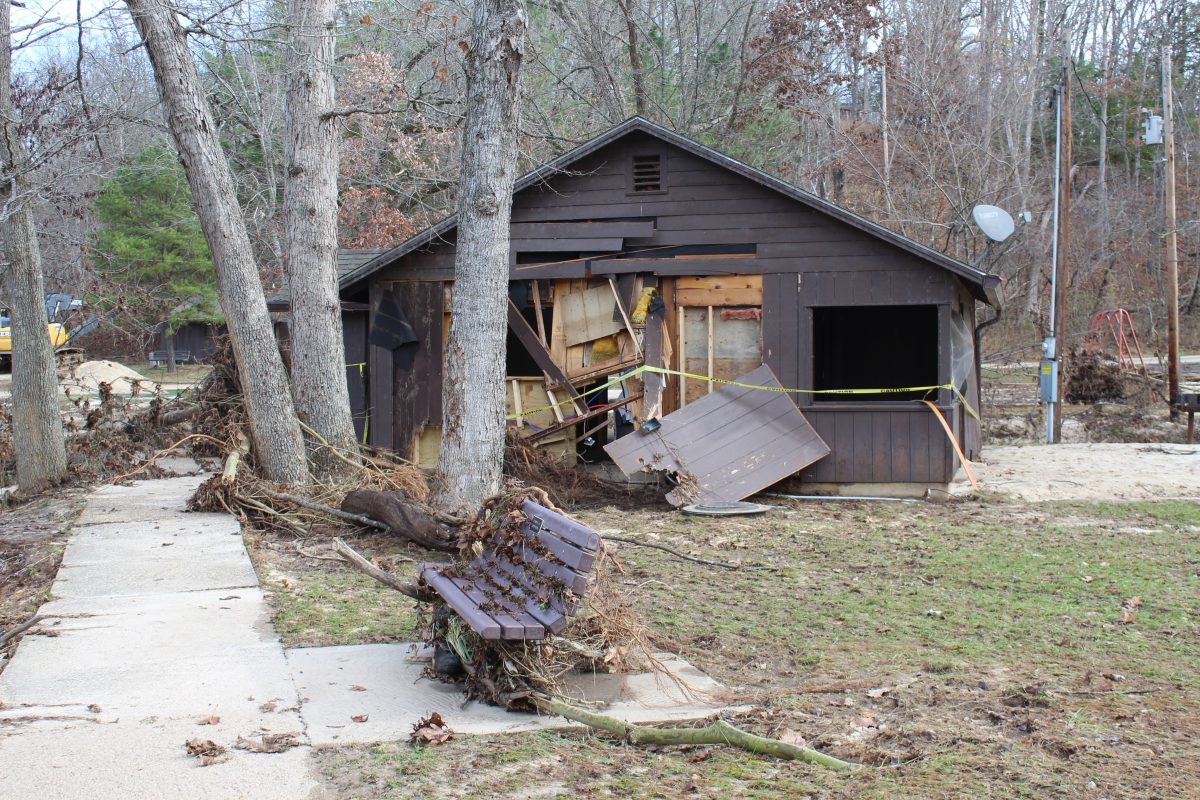
Photo by Shari Harris
Extensive damages to two cabins may make them unrepairable.
The large pavilion on the left looks barren, picnic tables washed to other locations throughout the park. The mill, damaged but standing, is surrounded by a sea of sand and even had sand deposited inside. The gravel from the parking lot washed away, likely into the raceways below. Siding damage and some foundation damage will have to be assessed for repair.
Crossing the bridge into the campgrounds, one has to stop a moment to take in all the destruction. Sand is everywhere, three feet deep in some places, along with downed trees, signs and picnic tables tangled among the piles of debris. Stranded trout have perished when the water receded.
The road has washed away completely in a couple of places, and makeshift repairs have been made to allow entrance into the campgrounds by workers.
Campsites will have to be evaluated one at a time, and picnic tables, campfire rings and electrical hookups will be repaired as needed.
Though flooding at the campgrounds is not uncommon, the water has not been this high before. It was the least busy time of year for visitors to the park, and thankfully no one was camping at the park at the time.
The water and wastewater systems were back up and running the next day, thanks to the efforts of park employees and Intercounty Electric, who replaced poles and restored power to most of the park.
Water came up to the back loading dock at the lodge, but thankfully the lodge did not sustain damage.
Statewide and regional DNR construction units were mobilizing to begin work this week. The park crews, with some help from other areas, have worked to get roads open and debris cleared, making everything safe for the construction units to come in.
Hatchery Manager Kyle Case and two other MDC employees were on the lodge side of the bridge when the flood hit.
“It came as a wall of water, so fast,” Case said. “It was unreal.”
The river broke over the levee behind the mill parking lot and flooded into the pools. The pumps flooded within 10 minutes. The water was two to three feet over the top of the levee at the other end of the pools; Case guessed it to be about 16 feet deep.
Prior to the flood, Case estimated he had about 950,000 trout in the pools. He doesn’t know what’s left, and it will take weeks to months to get a head count.
He and his crew have been working around the clock trying to save the fish. The first priority was getting water channeling through the rearing pools. That job is done. The next task is removing the debris. He was hoping to bring in tower lights on Monday to allow more hours of debris removal. After that task is complete, trout will have to be sorted by size, then counted. Among the debris removed from the pools was 10 picnic tables and lamps from the damaged cabins.
Pumps for the pools will have to be rebuilt, and that is already underway. The structure of the rearing pools appears to be intact, but fencing is down and mud and dirt cover everything.
Trout will look for a spot with the least amount of flow, Case explained, so he is hoping to find a lot that hunkered down in pools. He is seeing live trout in the pools. He believes ultimately there will not be as much fish loss as during previous floods due to getting the water flowing through the pools more quickly.
There was also about two feet of water in the hatchery office, Case said, but that is the least of his worries until the fish are cared for.
The northernmost part of the park’s watershed received 18.5 inches of rain, with even the least rain received topping 12 inches.
Although it is the least busy time of year for visitors to the park, there are always winter projects the staff has scheduled, and those are all on hold until the cleanup can be completed.
The park is closed until further notice, and they request that people do not try to come down and see the damage in order to give crews a chance to get work done.
Photos by Shari Harris




Holy crap! Do ya’ll need help cleaning up?
I wish I could come down and help but I am busy with school and other stuff. I hope they can get the park running smoothly again on opening day.