Shroud display continues through the week
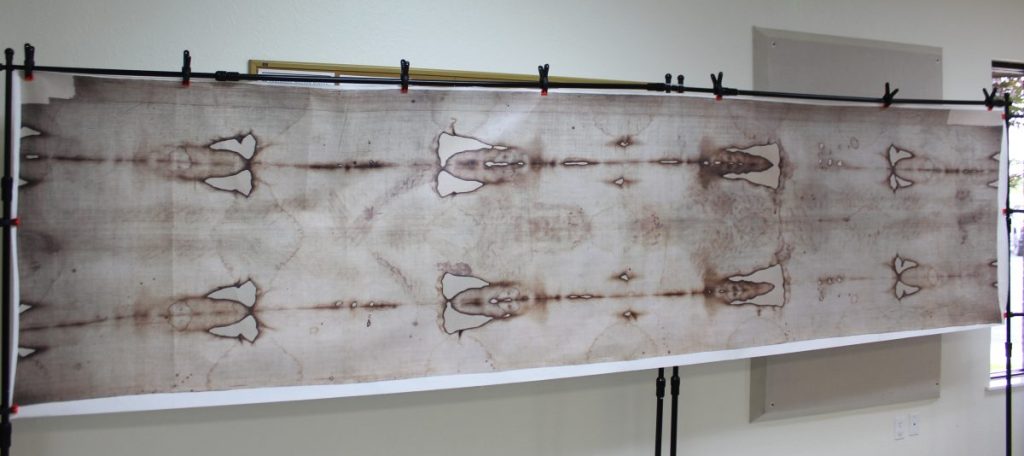
Photo by Shari Harris
Are you looking at the image of Christ? That is the question posed by the display of the Shroud of Turin.
By Shari Harris
Publisher
A replica of the Shroud of Turin will be on display through Friday at St. John the Baptist Catholic Church in Licking. Beginning on Sunday, the community was invited to view the display. The Shroud of Turin is believed by many to be the burial shroud of Jesus Christ, and its stains and markings bear witness to the torture inflicted on the body which it once covered.
The display offers compelling evidence as to the authenticity of the artifact. The Shroud of Turin is a 14 foot linen cloth which bears the image of a man. “An extremely brief intense burst of radiation” is believed to have created the photographic negative image on the cloth. Research shows the radiation that created the image could only have come from the body itself. The question of how the body emitted the burst of radiation remains unanswered.
The image on the shroud shows a nearly six feet tall man weighing 175 to 180 pounds, with long hair, a beard and an unbraided pigtail. The right eye and both eyebrows are swollen, the nose is deviated, and several other lacerations are on his cheeks. Marks made by a scourge, which is a leather thong with a pair of lead balls or round bones at the end, cover his chest, shoulders, back, buttocks and legs – 120 marks in all. Two abrasions on his back would correlate with where a crossbeam of a cross could have been carried. His knees are swollen and scraped, and wounds indicate where a single spike was driven at his crossed feet through his heels. Wounds at his wrists are also consistent with a Roman crucifixion. The flow of blood on his forearms assumes a jagged path, as it would if one alternated positions while suspended on a cross, between sagging and putting pressure on the spikes at the wrists, or putting pressure on the spike at the feet (which would aid breathing), both of which would certainly be excruciatingly painful. A large blood stain on the side of the chest is consistent with where a Roman soldier pierced the side of Jesus with a lance. The shroud was beneath the body, wrapped over the top of the head and down the front to fully cover it. The marks where it covered the scalp indicate something similar to a cap of thorns covering the entire scalp. There are no signs of physical decomposition in the image.
This particular combination of physical injuries would have been unlikely in crucifixions of that time, but they correlate with what is known about the crucifixion of Christ.
Detailed research into the most minute details of the Shroud of Turin appear to verify its authenticity. Discoveries include invisible serum rings around the scourge marks, pollen found on the cloth unique to the Jerusalem area, bilirubin and creatinine/ferritin nanoparticles in the blood (which are indicative of torture), thumbs folded under as they would if paralyzed by a spike driven through the wrist, microscopic chips of limestone that match Jerusalem limestone, a 3-inch wide side strip sown on the main shroud with a stitch unique to the first century, a 3-D image which relates appropriately to the body-to-cloth distance, and the change in electron bonding of carbon atoms within the cloth indicating radiation
In the Cathedral San Salvador, in Oviedo, Spain, is another artifact, called the Sudarium of Oviedo. It is a blood-stained cloth which was believed to be the cloth wrapped around the head of Jesus after he died. This custom was a sign of respect and compassion for the family of a deceased person during that time period. The blood found on the Sudarium matches the type of that found on the Shroud of Turin. Furthermore, if the Sudarium is placed over the shroud, marks on them align to show they covered the same man.
The Shroud is believed to have traveled from Jerusalem to Antioch and/or Edessa, Turkey; Constantinople; Lirey, France; and across France to Italy. It is mentioned intermittently in written records during those early centuries. In 1578, it was taken from France to Turin, Italy, and it remains there today.
The display was brought to Licking thanks to three years of effort by Cronan McCarthy. It will be available to view through Friday, July 26. You may call 573-247-2608 or 573-674-3614 for more information on times to see the shroud.
Photos by Shari Harris