More than a hobby
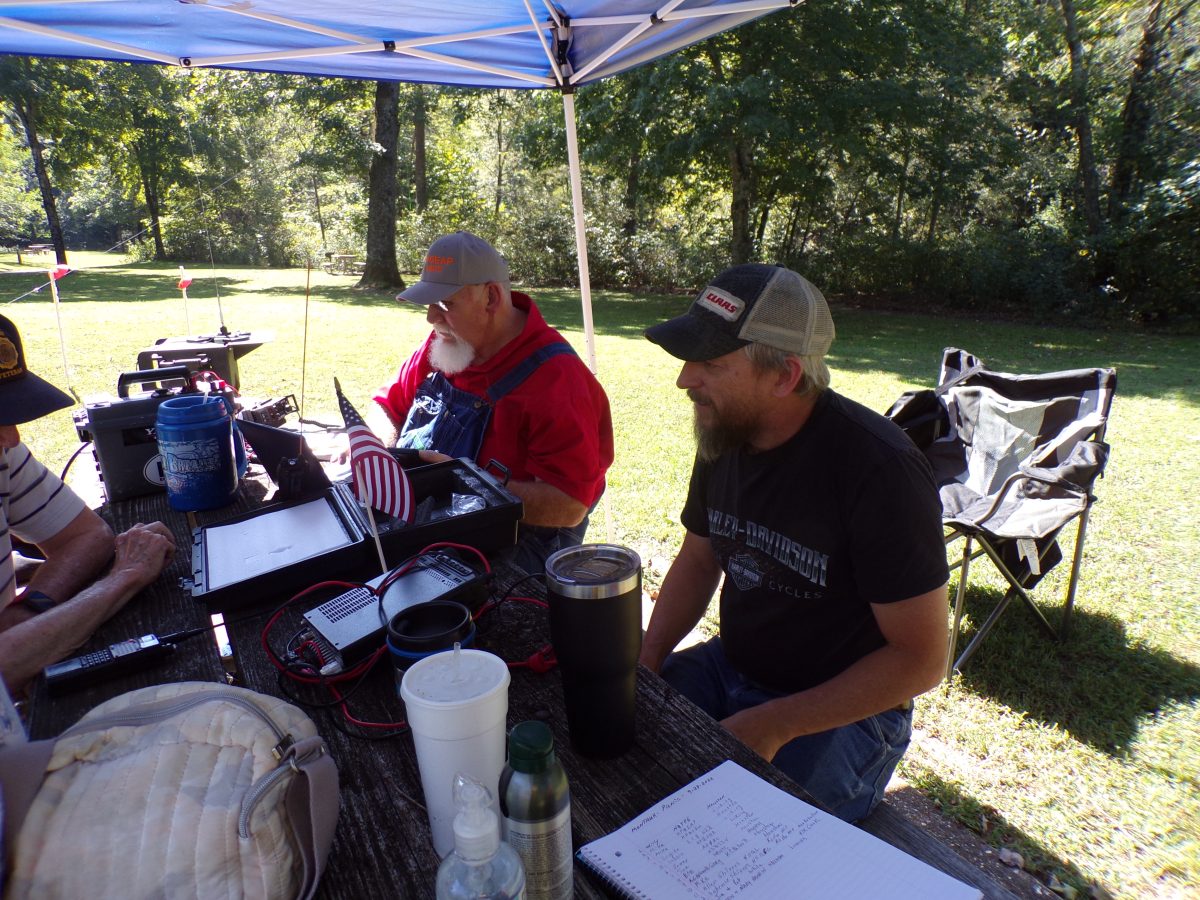
Photo courtesy of OMARC
OMARC members set up emergency communications at Montauk.
By Shari Harris, Publisher
Have you been thinking of starting a new hobby, but wanted something more than a pastime? The Ozark Mountain Amateur Radio Club (OMARC) may have your answer.
On the afternoon of Saturday, June 28, members of OMARC participated in the 2025 Annual AARL Field Day. AARL is the National Association for Amateur Radio, and twice each year, in January and June, they have field days to practice for emergency communications. Though the rain delayed their setup of equipment outside the former Pizza Express in Houston, OMARC members were able to finally get their radios ready around 4 p.m. and made contact with other operators all over the United States and in Canada, about 25 contacts in all. In the past, operators have set up antennas in the rain and run lines inside a shelter to operate their radios, but a break in the weather prevented them from having to take this step on Saturday. Over 30,000 operators were anticipated to participate in Saturday’s field day.
You may have heard amateur radio called ham radio. Ham radio may have gotten its name from the station call of the first amateur wireless station, operated by Albert Hyman, Bob Almy and Poogie Murray, of the Harvard Radio Club, who shortened their call to the first letter of their last names, HAM. Another theory is that it was a derogatory term used by professional telegraph operators, who considered amateur radio users as clumsy or ham-fisted when using Morse code.
Over the decades, amateur radio has evolved, and now you don’t even need to know Morse code to be licensed. A small investment in equipment (a radio and antenna), and a Technician’s License will have you on your way. There are 35 questions on the exam, and OMARC is willing to help you get your license, or you can study online. In addition to the Technician’s License, there are two other license levels – a General License, and an Extra License, which allows the operator to have all the privileges.
Amateur radio operators are more than just hobbyists. They are important members of the community during an emergency, providing contact to the State Emergency Management Agency and Federal Emergency Management Agency when phone lines and towers are unable to carry signals, or power is out. The battery- or solar-powered wireless radio is designed to work when other systems fail. Another function ham operators have is reporting severe weather damage. Every Tuesday evening at 7 p.m. the National Weather Service in Springfield links with local operators to test communications, and whenever there is severe weather in the area, they bring up links so local operators can report damages.
After the devastation of Hurricane Helene in September 2024, ham radio operators provided the only contacts in western North Carolina and eastern Tennessee, for two to three days, in some cases. Needs were identified for those trapped on the tops of mountains and supplies were air-dropped, based on communications received through ham radios. They have also played an important role in western wildfires and in other hurricanes. One member of OMARC has traveled with his church to disasters, bringing his radio to assist with communications.
If you are interested in learning more about ham radio, contact OMARC president Willie Adey at 417-260-4626. OMARC meets every third Saturday of the month at noon at the University Extension office in Houston. The club has been in existence since around 1970, and usually has around 30 members. They welcome those who are interested in learning more about ham radio.