Shroud of Turin display returns to Licking
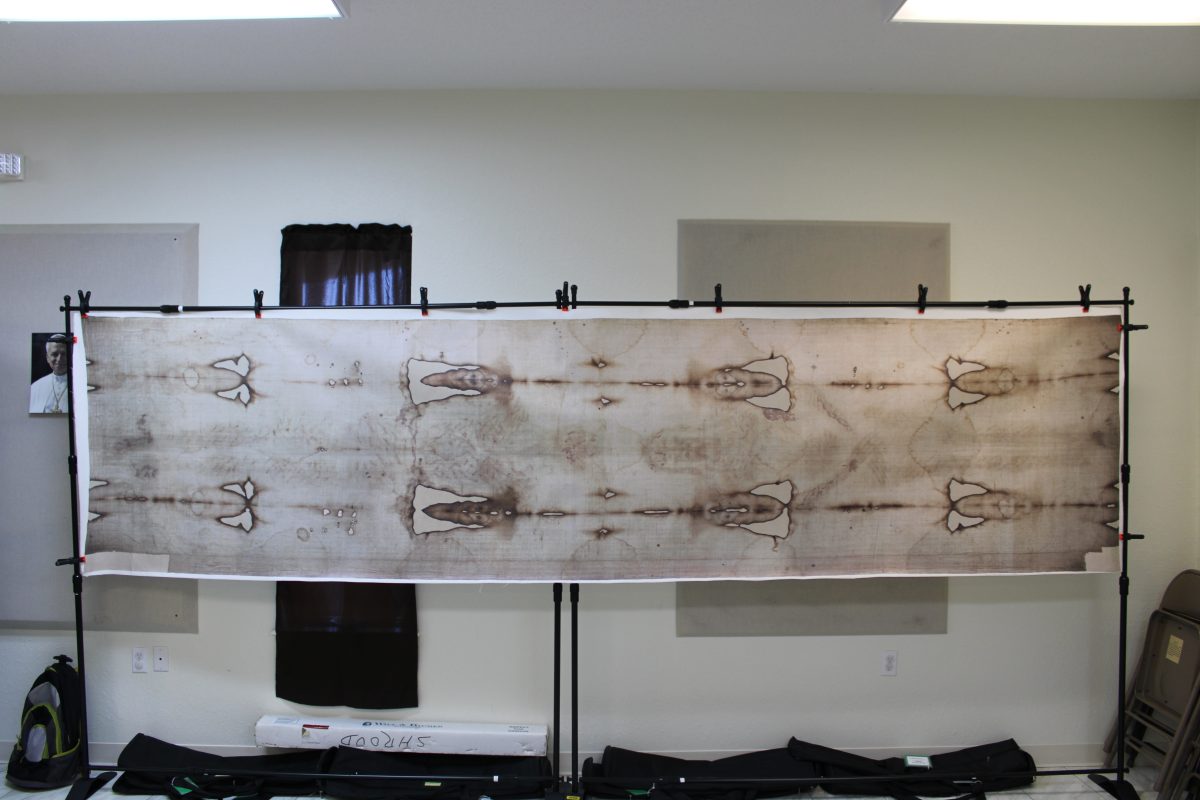
Photo by Shari Harris
This full-size replica of the Shroud of Turin was on display in Licking. It is believed by many to have been the burial shroud of Jesus Christ, and to contain his image.
By Shari Harris, Publisher
The Shroud of Turin display was hosted again this year by St. John the Baptist Catholic Church in Licking. The public was invited to view the display, which included a full-size replica of the shroud, on Sunday and Tuesday of last week.
The Shroud of Turin is a 14-foot linen cloth which was presented to a church in the French city of Lirey in the 1350s by a French knight. He claimed the cloth was the authentic burial shroud of Jesus Christ.
In 1453, the knight’s granddaughter exchanged the cloth with the Royal House of Savoy in France for two castles. The House of Savoy placed the cloth in the Sante-Chapelle in Chambrey in 1502. In 1532, a fire in the chapel melted part of the silver in the container in which the cloth was kept, leaving burn marks on it. In 1578 it was taken to Turin, Italy, where it remains to this day. The Shroud is on display in the Church of St. John the Baptist in Turin.
Much research has been conducted on the Shroud. In 1978 pollen grains found on it were identified as coming from flowers which are known to have grown in Jerusalem in the time of Christ. Some of those flowers identified have never grown in Europe, where claims originate that the Shroud is a forgery. Areas on the cloth where it would have contacted the soles of the feet and knees contained particles of limestone found only in the Jerusalem tomb areas.
In 2022, Wide-Angle X-ray Scattering (WAXS) was used to determine the age of the Shroud, and it was found to be roughly 2,000 years old.
A team of 30 scientists in 1978 studied the Shroud, and in 1981, they concluded that “no pigments, paints, dyes or stains have been found on the fibers.”
“Computer enhancement and analysis show that the image has unique three dimensional information encoded in it and will produce a three dimensional image. It is clear that there has been a direct contact of the Shroud with a body which explains certain features such as scourge marks, as well as blood,” they continued.
“We can conclude for now that the Shroud image is that of a real human form of a scourged, crucified man. It is not the product of an artist. The bloodstains are real human blood, type AB with male DNA.”
These scientists’ conclusions leave little doubt that the Shroud of Turin is, indeed, a burial shroud. Further evidence exists linking it to Jesus Christ. The image of the crucified man which was left on the Shroud shows a man who had been scourged, beaten about the face with swelling to the left cheek and a broken nose, who had fallen numerous times with wounds on the knees, had many puncture wounds about the head, wounds on both wrists and feet, a piercing to his side and bruising with lacerations to the right shoulder.
Jesus was scourged, had a crown of thorns placed upon his head, and was nailed to the cross. His side was pierced as well. Other Roman crucifixions were not conducted in the same manner as the crucifixion of Jesus, therefore it would not be expected that others who were crucified would have these precise wounds.
Another interesting piece of evidence is a bloodstained cloth measuring approximately 33”x21” which is kept in the Cathedral San Salvador in Oviedo, Spain. This cloth is thought to be the cloth that was wrapped around the head of Jesus after he died as he was taken down from the cross, which was the custom at the time. The blood stains on this cloth are also type AB, and if this cloth, called the Sudarium of Oviedo, is placed over the shroud, the marks match up and prove that they covered the same man.
Though tantalizing evidence is presented to suggest that the Shroud of Turin is truly the burial cloth of Christ, it is left to the individual to come to their own conclusions. Regardless of what one decides, the life size replica of the Shroud of Turin can still serve as a reminder of the sacrifices made by Christ on the cross. The blood stains depict the suffering he endured for the salvation of mankind and will surely give many pause for reflection and thanksgiving.